
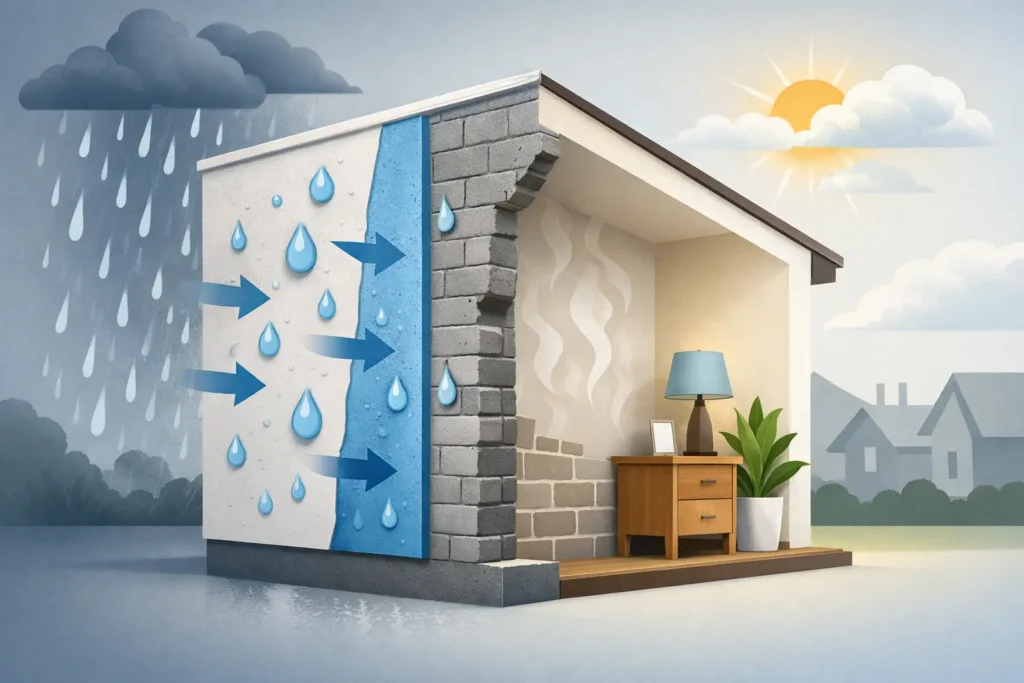
If you are looking at stained internal walls, bubbling paint or a patchy exterior and asking, does render stop moisture, the honest answer is no - not by itself, and not in every situation. Render can help manage water on the outside of a building, but it is not a cure-all for damp problems. If the source of moisture is not identified properly, rendering over the issue can trap it, hide it for a while, or make the damage harder to see until it becomes more expensive to fix.
That is where a lot of property owners get caught. Render is often seen as both a finish and a fix. It certainly improves presentation, and in the right system it adds a protective layer to exterior walls. But moisture behaves differently depending on whether it is coming from rain penetration, rising damp, plumbing leaks, condensation, failed seals, cracked masonry or poor drainage around the building.
Does render stop moisture on exterior walls?
Render can reduce the amount of wind-driven rain that reaches the wall surface, especially when the existing substrate is porous, aged or cracked. A well-applied render system also helps by creating a more uniform, sealed outer skin that sheds water better than tired brickwork or deteriorated masonry. That is one reason properly specified render is valued on homes and commercial buildings exposed to harsh weather.
But saying render stops moisture is too broad. Standard cement render is not a waterproof membrane. It is water-resistant to a degree, but it can still absorb moisture, develop hairline cracks and allow water ingress if the substrate moves or if the installation is poor. Acrylic render systems generally offer better flexibility and improved resistance to cracking, which can help limit water penetration over time, but even acrylic products need correct detailing, preparation and finishing.
The short version is this: render can help protect a wall from external moisture exposure, but it does not make a building immune to damp.
What render actually does
A good render system is part of a wall protection strategy. It improves the surface, closes minor imperfections, provides a cleaner finished appearance and can improve weather resistance. On older walls, it can also assist with durability by covering worn masonry that is no longer performing well on its own.
Where render performs best is on sound substrates that have been prepared correctly. If cracks are repaired, movement issues are addressed, flashings and sealants are in good order, and the chosen render suits the wall type, the finished system has a much better chance of keeping water where it belongs - outside.
That said, no render should be expected to solve structural cracking, failed damp-proof courses, leaking roofs or overflowing gutters. Those are building issues first and finishing issues second.
When render makes moisture problems worse
This is the part many contractors gloss over. If a wall already has trapped moisture, adding render without diagnosing the cause can create bigger problems.
Moisture needs a path. If water is entering from behind the wall, rising from below, or condensing internally, a new rendered finish may simply cover the symptoms. Over time, that can lead to blistering, delamination, efflorescence, mould growth or render failure. In some cases, the render itself gets blamed when the actual problem sits deeper in the wall assembly.
This is especially relevant in renovation work. Older properties may have a mix of materials, previous patch repairs, cracked mortar joints and changed ground levels. If those issues are not checked first, a fresh render finish can look excellent on day one and underperform far too early.
The source of moisture matters
To answer does render stop moisture properly, you have to start with where the moisture is coming from.
If the issue is rain hitting an external wall, render can absolutely play a useful role in protection. If the issue is a leaking pipe inside the cavity, render will not stop it. If the problem is rising damp from the base of the wall, render alone will not solve it and may trap salts or moisture in the substrate. If the issue is condensation from poor ventilation, the wall finish is only one part of the picture.
That is why experienced assessment matters. The same visible stain can come from very different causes. Treating all damp as a surface problem is one of the fastest ways to waste money.
Which render is better for moisture resistance?
Not all render systems perform the same way around moisture.
Cement render remains a common choice because it is durable, cost-effective and suits many masonry surfaces. However, it is more rigid than acrylic systems, which means it can be more prone to cracking if there is movement in the substrate. Once cracking starts, water can find a way in.
Acrylic render generally offers better flexibility and stronger adhesion across a wider range of surfaces. That flexibility is valuable because small movement cracks are one of the main ways moisture gets past a rendered surface. Acrylic systems can also be paired with mesh reinforcement and suitable coatings to improve long-term performance.
In some applications, a full system approach matters more than the base render product alone. That may include crack repairs, primers, reinforcing mesh, texture coatings and final protective finishes selected for the wall condition and exposure level. For buildings in Melbourne dealing with seasonal moisture, wind-driven rain and temperature variation, that system thinking is far more reliable than choosing a product based on price alone.
Cracks, joints and detailing matter more than most people think
A rendered wall does not fail only because of the render. It often fails because water enters through the weak points around it.
Window surrounds, door frames, expansion joints, parapets, coping details and service penetrations are all common trouble spots. If these areas are not sealed and finished correctly, water can bypass the rendered face altogether. You may then see damp appear internally and assume the render did not work, when in reality the moisture entered through an adjacent detail.
The same applies to cracks. Even fine cracks can allow moisture ingress under repeated exposure. Proper crack repair before rendering is not a cosmetic extra. It is part of how the wall performs over time.
Can render help prevent future damp issues?
Yes, in the right circumstances. If the building is structurally sound and the main issue is surface porosity, weather exposure or aged external finishes, a professionally installed render system can improve resistance to moisture ingress and extend the life of the façade.
It is also useful where external walls have become uneven, patchy or vulnerable after years of wear. Rendering gives you the chance to restore both protection and appearance in one process. That is particularly valuable for owners trying to improve street appeal without ignoring practical durability.
But there is a condition attached to that benefit. Prevention only works when prep work is taken seriously. Substrate condition, moisture levels, crack treatment, compatible materials and correct curing all matter. Shortcuts at this stage usually show up later as staining, cracking or premature coating breakdown.
Signs render alone is not the answer
If damp marks keep returning internally, if salts are pushing through the wall, if paint is lifting near the base of the wall, or if moisture appears after rain even where the render looks intact, there is likely a deeper issue to inspect. Likewise, musty smells, mould growth and persistent bubbling are signs that the moisture source may be inside the wall or coming from another building element.
In these situations, rendering should come after diagnosis, not before it. A good contractor will tell you when another repair needs to happen first.
The practical answer for property owners
If you are deciding whether to render a wall with moisture concerns, the best approach is simple. First identify the source of the moisture. Then assess the substrate condition. Then choose a render system that matches the wall type, exposure level and long-term performance needs.
That process is less about selling a finish and more about protecting the building properly. For homeowners, renovators and builders, that means fewer surprises later. For investment and commercial properties, it means better durability, lower maintenance risk and a finish that holds up as it should.
At Australian Rendering Company, this is exactly why moisture concerns should never be treated as a one-size-fits-all problem. Good rendering improves performance, but only when the groundwork is right and the system is applied with trade knowledge.
So, does render stop moisture? Sometimes it helps control external moisture exposure, and sometimes it simply covers a problem that should have been fixed first. The difference comes down to diagnosis, preparation and workmanship - and that is where the real value sits.