
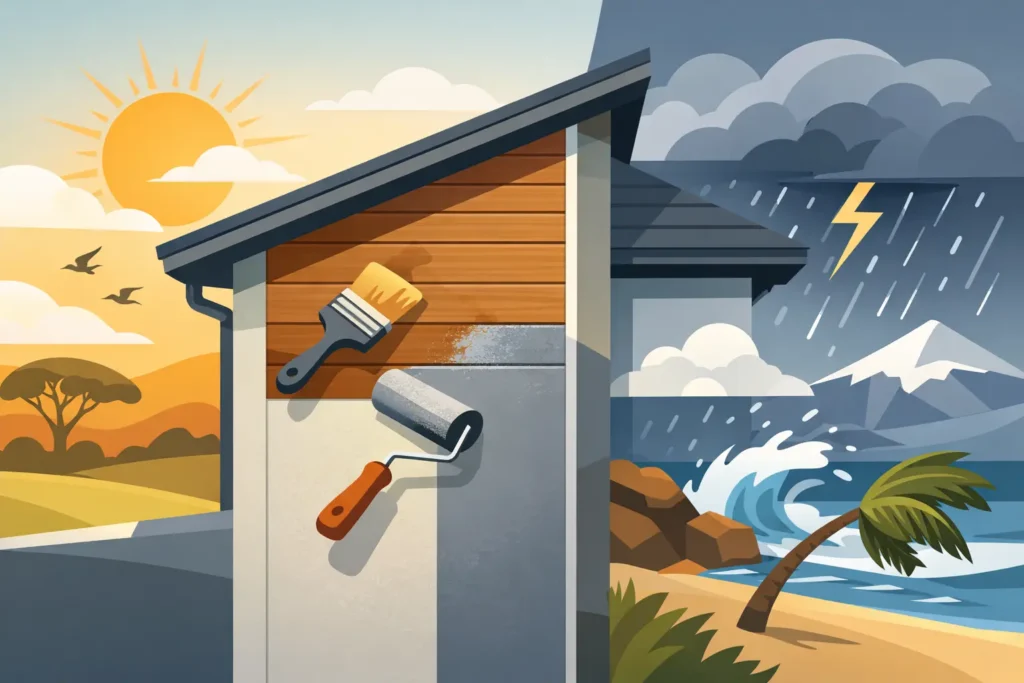
A wall can look sharp on handover day and still fail its first hard test six months later. Summer UV, wind-driven rain, cold wet winters and normal building movement all work on an exterior surface. That is why choosing the best finishes for Australian weather is less about picking a texture from a colour chart and more about selecting a complete system that suits the wall beneath it.
For Melbourne homes and commercial buildings, the right finish needs to manage moisture, tolerate movement and retain its appearance through changing conditions. Good workmanship matters just as much as the material. A premium coating applied over unstable render, untreated cracks or poor drainage will not deliver a long-lasting result.
What Australian weather asks of an exterior finish
Australian conditions are varied, but several pressures are common across most properties. Strong ultraviolet exposure can fade colour and gradually break down lower-grade coatings. Rain finds its way into unsealed junctions, failed flashings and existing cracks. In cooler periods, damp walls can stay wet long enough for staining, mould and coating failure to become visible.
Walls also move. Brickwork, concrete, lightweight cladding and framed construction expand, contract and settle at different rates. A finish that is too rigid for the substrate can crack, even when the original application was neat. Conversely, a coating that is too soft or poorly prepared may mark easily, hold dirt or lose adhesion.
The practical answer is to assess the substrate, its condition, exposure and the level of maintenance the owner is prepared to undertake. There is no single finish that is right for every façade.
The best finishes for Australian weather depend on the wall
Acrylic render for flexibility and weather resistance
Acrylic render is one of the most practical exterior finishes for many residential properties. It is applied as a cement-based or polymer-modified render system, often with an acrylic texture coat and protective paint system. Its key advantage is flexibility. Compared with traditional cement render alone, acrylic finishes better accommodate minor movement in the wall and are less prone to superficial cracking.
This makes acrylic rendering particularly suitable for fibre cement sheet, lightweight construction, polystyrene cladding systems and many rendered masonry walls. It also provides a broad choice of textures, from a fine modern finish to a more pronounced sand texture that can help disguise minor surface variation.
Acrylic is not a licence to skip preparation. Control joints, flashing details, sealant joints and crack repairs must still be handled properly. If water is entering behind the finish, the wall needs that cause addressed before rendering begins.
Cement render for solid masonry and traditional character
Cement render remains a reliable option for brick, blockwork and concrete where a strong, traditional rendered surface is required. When mixed and applied correctly, it creates a durable base that can be finished smooth, textured or prepared for painting. It is a proven choice for older homes, boundary walls, retaining walls and commercial masonry surfaces.
Its trade-off is rigidity. Cement render does not flex as readily as an acrylic system, so it requires sound substrate preparation and appropriate joints. On walls with active cracking or noticeable structural movement, applying new cement render over the top without investigation simply transfers the problem into the new finish.
For exposed masonry, cement render is often at its best as part of a layered system: properly prepared substrate, suitable render thickness, curing time, compatible texture or paint, and careful sealing around penetrations and wall junctions.
Concrete finishes for strength and a clean architectural look
Concrete render finishes suit properties seeking a crisp, contemporary appearance while retaining the strength needed for demanding exterior locations. They can be used to refine uneven concrete, repair deteriorated surfaces or create a uniform façade across extensions and altered sections of a building.
The finish should be selected with the exposure in mind. A very smooth, dark surface can highlight patching, water marks and minor imperfections more readily than a lightly textured finish. On an exposed elevation, a practical texture and quality exterior coating will usually remain looking cleaner for longer.
Concrete surfaces must also be assessed for cracks, spalling, loose material and moisture issues before any new finish is applied. A surface coating can improve appearance and protection, but it cannot replace proper concrete repair where the substrate is failing.
Polystyrene cladding for insulation and façade renewal
Polystyrene cladding, also known as EPS cladding, can be an effective choice when a property needs a major visual upgrade along with improved thermal performance. The system uses lightweight insulation boards fixed to the wall, then finished with reinforced render and an acrylic coating system.
For older brick homes, it can create a fresh rendered appearance without the need to build a new masonry skin. The insulation layer can also help reduce heat transfer through the wall, which is valuable in Melbourne's hot summers and cold winters.
The detail work is critical. Windows, doors, roof lines, drainage points and ground clearances all need to be properly managed. EPS cladding performs well when installed as a complete engineered system, not as a cosmetic shortcut. Mesh reinforcement, corner beads, compatible base coats and correctly formed joints protect the finish from impact and movement.
Hebel cladding for durable lightweight construction
Hebel cladding provides another strong option for lightweight external walls. Made from autoclaved aerated concrete, Hebel panels offer solid feel, thermal benefits and fire-performance advantages when used in the right compliant system. They are commonly used in new builds, upper-storey additions and architectural façade designs.
A rendered Hebel façade requires compatible jointing, reinforcing and coating products. The panel joints are a key detail because movement or poor treatment at those points can show through the finish over time. When the system is installed and finished correctly, Hebel offers a durable, modern surface that suits many Melbourne building styles.
Coatings and colour are part of the protection system
The top coat is not merely decorative. A quality exterior coating helps protect render and cladding from UV, moisture and surface dirt. It should be compatible with the render or cladding system underneath, applied after the required curing period, and maintained according to its exposure.
Colour choice also has a practical impact. Dark colours can absorb more heat, placing extra stress on sun-facing walls and making small surface imperfections more noticeable. This does not mean dark façades are off limits, but they demand better substrate preparation and an appropriate coating system. Lighter and mid-tone colours generally cope well with harsh sun and tend to be more forgiving over time.
Textured finishes are often the sensible choice for family homes, fences and large exterior walls. A fine texture can soften minor waviness and make future touch-ups less obvious than a perfectly smooth finish. Very heavy texture, however, can collect dust and be harder to clean. The best option is usually one that matches the building style without creating unnecessary maintenance.
Crack repair comes before the new finish
Cracks are where many exterior upgrades go wrong. Some are minor shrinkage cracks in old render. Others point to movement, water damage, failed joints or substrate issues that need closer attention. Treating every crack with the same filler is not professional repair work.
The crack needs to be assessed first. Stable hairline cracking may be repaired and reinforced before recoating. Larger or recurring cracks may require cutting out loose render, repairing the substrate, embedding mesh or allowing for a flexible joint. Where cracking suggests structural movement, advice from the appropriate building professional may be required before cosmetic work proceeds.
This preparation is what gives a new render or cladding finish a fair chance of lasting. Covering damage may improve the appearance briefly, but it does not protect the property in the long term.
How to choose the right finish for your project
Start with the wall, not the look. Masonry in good condition may suit cement render or an acrylic render system. Lightweight walls often benefit from a flexible acrylic approach. If insulation and a full façade upgrade are priorities, EPS or Hebel cladding may be the better investment.
Next, consider exposure. A protected courtyard wall has different needs from a west-facing façade that receives afternoon heat and rain. Finally, look at details that are easy to overlook: roof drainage, window sealing, weep paths, ground clearance and existing repairs. These details often decide whether a finish remains sound or starts to stain and crack.
The finish worth choosing is the one that fits the building, has been prepared properly and is installed without shortcuts. A careful assessment before work starts will protect the appearance of the façade and save far more than a quick cosmetic repair ever will.