
If you're weighing up hebel cladding vs polystyrene cladding, you're probably not just choosing a finish - you're choosing how your home will handle weather, movement, maintenance and day-to-day wear over time. On paper, both can improve appearance and insulation. On site, they behave very differently.
For homeowners, renovators and builders, the right choice usually comes down to the building itself, the budget, the performance required and the finish you want to achieve. There is no one-size-fits-all answer. What matters is choosing a system that suits the project, not just the brochure.
Hebel cladding vs polystyrene cladding: what is the difference?
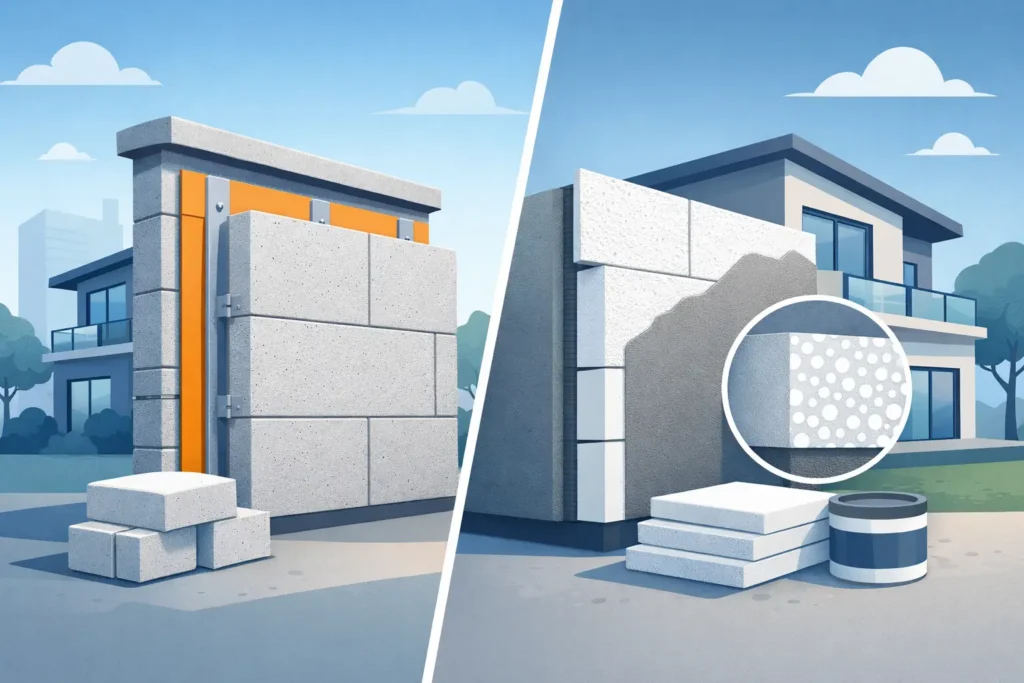
Hebel is an autoclaved aerated concrete panel system. It is lightweight compared with traditional masonry, but still gives you a solid, dense cladding material with good fire performance, acoustic benefits and a strong rendered finish. It is commonly used where owners want a more substantial wall system without the weight of full brick or concrete construction.
Polystyrene cladding is a lightweight foam-based system, typically installed with reinforcing mesh and coated with an acrylic or cement-based render finish. Its main strengths are thermal performance, design flexibility and lower weight. It is often chosen for façade upgrades, decorative features, lightweight construction and projects where insulation is a major priority.
Both systems can be rendered for a clean modern finish. Both need proper installation. And both will underperform if shortcuts are taken with framing, joint treatment, coatings or waterproofing details.
How Hebel performs on Australian homes
Hebel appeals to property owners who want a cladding system that feels more solid and durable under impact than lighter alternatives. It is well suited to external walls where strength, fire resistance and acoustic performance matter. In practical terms, it gives a home a sturdy outer skin that works well with contemporary rendered finishes.
One of Hebel's biggest advantages is its fire performance. In many residential and commercial settings, that is a serious consideration rather than a sales point. It can also help with sound reduction, which is useful on busy roads or higher-density sites.
From a finish perspective, Hebel provides a flat, stable base when installed correctly. That can translate to a high-quality rendered appearance with strong lines and a more substantial feel. For many clients, that finish quality matters just as much as the technical specs.
The trade-off is cost and complexity. Hebel systems are generally more expensive than polystyrene, both in materials and installation. They also require proper detailing at joints, openings and penetrations. If the installation is poor, cracking and moisture issues can still occur. A good product does not make up for bad workmanship.
How polystyrene cladding performs
Polystyrene cladding is often selected because it is lightweight, efficient and versatile. It puts less load on the structure, which can be useful in renovations, extensions and projects where existing walls or framing make heavier systems less practical. It also allows for a wide range of shapes, profiles and architectural detailing.
Its insulation value is one of its biggest advantages. For homes that get hammered by summer heat or need better thermal control in winter, polystyrene can make a noticeable difference when designed and installed properly. That can improve comfort and help with energy efficiency.
Cost is another reason many owners consider it. In many cases, polystyrene cladding can be more budget-friendly than Hebel, especially where the project is focused on appearance and insulation rather than a more solid wall build-up.
The trade-off is impact resistance. Polystyrene systems are not as solid as Hebel. They rely heavily on the reinforcing mesh, base coat and finish coat working together as a complete system. If lower-grade materials are used, or if details are rushed, the finished surface can be more vulnerable to damage, moisture ingress and movement-related cracking.
Cost differences: upfront and long term
For many projects, budget narrows the decision quickly. Hebel typically has a higher upfront cost than polystyrene cladding. That includes not only the panel system itself, but also the handling, fixing methods, jointing and finishing requirements.
Polystyrene is often the more economical option at the start. It can be faster to install and may reduce labour and structural demands on some jobs. That said, cheapest at quote stage is not always cheapest over the life of the building.
Long-term value depends on where the cladding is going and what the building needs to withstand. If the wall is exposed to knocks, traffic, weather extremes or stricter compliance requirements, paying more for Hebel may make sense. If the priority is lightweight insulation and façade improvement on a suitable substrate, polystyrene may be the smarter spend.
Fire, moisture and durability
This is where product choice needs to be practical, not emotional. Hebel generally offers stronger fire performance and a more solid exterior shell. That can make it a better fit for certain boundary conditions, compliance needs and owners who want a higher level of confidence in the wall system.
Polystyrene cladding systems can still perform well, but they must be specified and installed correctly, with suitable coatings and compliance in mind. Not every foam-based system is the same, and not every installer treats detailing with the same care. Fire considerations should always be assessed against the actual product system and the building's requirements.
Moisture performance in both systems comes back to workmanship. Neither Hebel nor polystyrene should be treated as a magic fix for poor detailing. Flashings, sealants, control joints, membrane work and penetrations all matter. In Melbourne conditions, where buildings can cop driving rain, cold mornings and hot afternoons across the same week, those details are not optional.
Finish quality and appearance
Both Hebel and polystyrene cladding can produce an attractive rendered façade. The difference is often in how the wall feels, how sharp the details remain over time and how the system handles movement and minor impacts.
Hebel tends to suit clients chasing a more substantial result. It often feels closer to a masonry-style outcome once rendered. On larger wall areas, that can give a premium appearance.
Polystyrene works well for modern design features, lightweight façades and decorative shapes. It can be an excellent option for refreshing a dated exterior without overloading the structure. But the finished result depends heavily on the coating system and the quality of the installer. Good polystyrene cladding can look excellent. Poorly installed polystyrene cladding looks tired quickly.
Which one is better for renovations?
In renovation work, the better system often depends on the existing building. If the structure cannot easily take extra weight, polystyrene may be the practical option. If the goal is to upgrade a façade, improve insulation and modernise the look without major structural changes, it can be a very effective solution.
If the renovation calls for a tougher, more solid external wall system, Hebel may be worth the higher investment. It is often chosen where owners are doing broader façade improvement works and want durability to match the new appearance.
This is also where an experienced contractor adds value. On older homes, wall condition, substrate stability and previous coatings all affect how well a cladding system will perform. The best choice is the one that suits the actual building, not the one that sounds best in a sales pitch.
Hebel cladding vs polystyrene cladding: which should you choose?
Choose Hebel if you want a more solid cladding system, stronger fire performance, good acoustic benefits and a durable rendered finish, and you're prepared for a higher upfront cost.
Choose polystyrene cladding if weight, insulation, design flexibility and budget are the main drivers, and the system is being installed by a contractor who understands proper mesh, coatings and detailing.
For many Melbourne properties, climate exposure also plays a part. A façade that looks good for the first year is not the goal. What matters is how it stands up through heat, rain, movement and everyday wear. That is why product selection and workmanship need to go together.
At Australian Rendering Company, we look at cladding choices the same way we approach every surface finish - by matching the system to the building, the conditions and the result the client wants to achieve. A well-specified job done properly will always outperform a cheaper shortcut.
If you're deciding between Hebel and polystyrene, the most useful next step is not guessing which one is better in general. It is getting clear on which one is better for your walls, your budget and how long you expect the finish to last.