
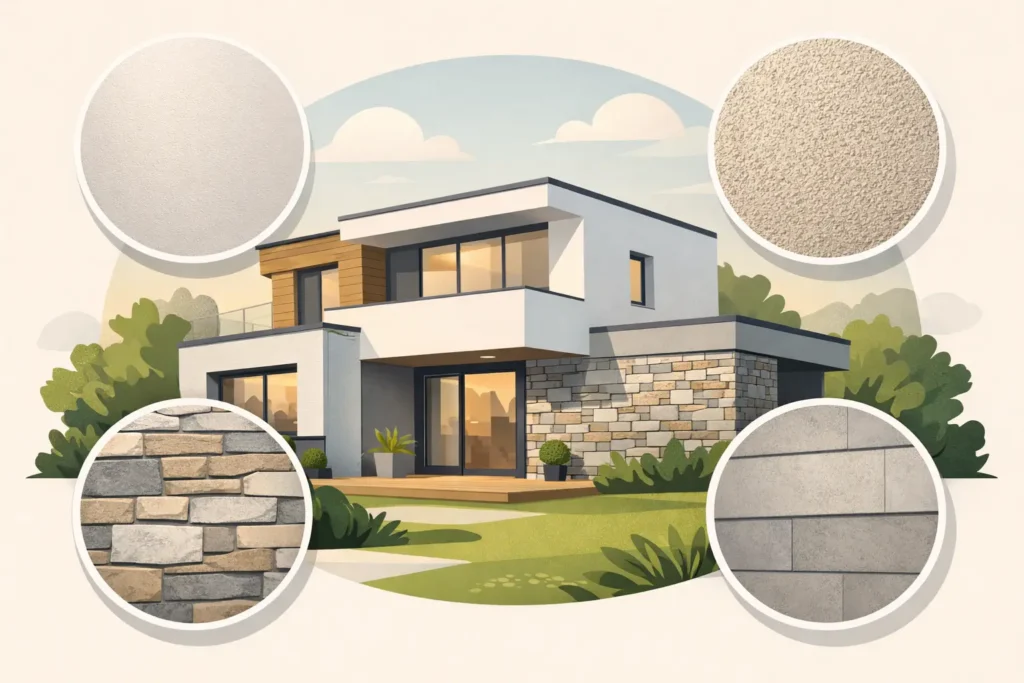
A render finish can make a house look sharp and contemporary, soften an older façade, or hide years of wear in one well-planned upgrade. Choosing the best render textures for homes is not just about appearance. It affects how well walls handle weather, how much maintenance you take on, and whether the finished job suits the age and style of the property.
For most homeowners, the right texture sits somewhere between looks, durability and practicality. A finish that looks excellent on a new architectural build may not be the best choice for a renovation with patched masonry or hairline movement. The texture needs to suit the substrate, the exposure to sun and rain, and the standard of finish you want to live with long term.
What makes a render texture the right choice
Texture changes more than the look of a wall. It influences how light hits the surface, how noticeable imperfections are, and how easy the wall is to clean or repaint later. Smoother finishes tend to look more refined and modern, but they can also show substrate variation, patching and minor workmanship inconsistencies more clearly. Heavier textures are often more forgiving and can be a smart choice where walls are older or less uniform.
Australian conditions matter here as well. On homes exposed to strong UV, driving rain and regular temperature changes, the finish needs to do more than look good on handover day. It needs to hold up without excessive cracking, early fading or surface breakdown. That is why the best result usually comes from matching the texture to the right render system, rather than choosing the look first and hoping the product will suit.
Best render textures for homes and where they work best
There is no single texture that suits every property. The best option depends on the wall condition, architectural style and the level of maintenance you are comfortable with.
Smooth render finish
A smooth finish is often chosen for modern homes, extensions and façade updates where a clean, crisp appearance is the goal. It works well on contemporary designs with straight lines, contrasting materials and minimalist colour schemes. On the right surface, it gives a premium, high-end look.
The trade-off is that smooth render is less forgiving. If the substrate has uneven areas, previous repairs or visible movement, they can be more noticeable once finished. It also tends to show dirt, impact marks and surface imperfections more readily than a textured finish. For homeowners who want that sharp architectural result, preparation and application quality matter more than ever.
Sand finish
A sand finish has a fine grain through the surface, giving it more texture than a smooth render without becoming heavy or rough. This is one of the most versatile finishes for residential work because it balances appearance with practicality. It suits both new homes and renovations, and it can work across brick, block and rendered cladding systems.
This finish helps soften small imperfections while still looking neat and professional. It is also a sensible option for homeowners who want a finish that will not date quickly. In many cases, a sand finish sits in the middle ground - cleaner than a coarse texture, but more forgiving than a polished smooth wall.
Sponge finish
A sponge finish creates a lightly mottled texture that adds movement to the wall without looking heavy. It is commonly used where the owner wants a softer, more lived-in surface rather than a flat, uniform appearance. On many suburban homes, especially renovations, it gives a practical and visually balanced result.
One of the main advantages of sponge texture is that it helps disguise minor surface variation and everyday marks better than a very smooth finish. It is not as sharp or architectural in appearance, so it may not suit every design brief, but it performs well on family homes where durability and ease of upkeep are part of the decision.
Trowel finish
A trowel finish introduces more pronounced texture and can be worked to suit different design styles, from traditional to Mediterranean-inspired homes. This texture has more character and can create depth across large wall areas. It is often selected when the goal is to make the render itself a visible design feature.
Because the finish is more textured, it can do a good job of hiding inconsistent masonry or older surfaces. The downside is that deeper textures may collect more dust and can be slightly more involved to repaint down the track. Still, where the wall condition is less than perfect, a trowel finish can be a very practical choice.
Bagged or rustic finish
For older homes, feature walls or projects aiming for a more natural, textured appearance, a bagged or rustic finish can work well. It has a less formal look and can add warmth and character, especially on heritage-style renovations or garden walls and boundary features.
This is not usually the first choice for a crisp modern façade, but it has its place. When done properly, it can turn tired masonry into a finish with genuine visual interest rather than trying to force a sleek look onto a home that does not suit it.
How to choose the best render textures for homes
The first question is not which texture you like most. It is what type of wall you are working with. Brick, concrete block, blueboard, fibre cement and cladding systems all behave differently. Some surfaces are more prone to movement, some need reinforcement, and some require specific primers or base coats before the texture coat even goes on.
The second question is what the existing wall condition looks like. If the home has visible cracking, patch repairs or uneven masonry, a very smooth finish may create more problems than it solves. In that case, a texture with a bit more body often gives a better final result and better value for money.
Style matters too, but it should be considered alongside maintenance. Modern homes often suit smooth or fine sand finishes. Traditional homes can carry sponge, trowel or rustic textures more naturally. If the property is in a high-exposure area or on a busy street where walls gather grime, a finish that is slightly more forgiving can save frustration later.
Texture is only part of the system
A good render finish depends on more than the final texture coat. The base preparation, reinforcement, product compatibility and curing all affect how the job performs. This is where experience makes a real difference.
For example, acrylic rendering systems are often a strong choice for homes because they offer flexibility, adhesion and weather resistance. Cement-based systems still have their place, particularly on suitable masonry substrates, but they need to be specified and applied correctly. If there are existing cracks, those need to be assessed and repaired properly before any new finish goes over the top. Covering movement without addressing the cause usually leads to the same issue returning.
That is why a workmanship-first approach matters. The texture you see is the visible layer, but the long-term performance comes from the entire build-up underneath it.
Popular texture choices for Melbourne homes
In Melbourne, changing weather conditions can be hard on exterior surfaces. Homes can go from strong sun to cold, wet conditions quickly, and that puts pressure on coatings and finishes. For many properties, fine sand and sponge finishes are popular because they offer a clean look without being too unforgiving. They suit a wide range of home styles and handle everyday wear reasonably well.
Smooth finishes are still in demand, especially for newer builds and modern renovations, but they need the right substrate preparation to look their best. On older brick homes or properties with visible wall irregularities, a lightly textured finish often gives a better and more consistent outcome.
Getting the finish right the first time
The best-looking texture on a sample board can be the wrong choice on a full house if the wall condition, light exposure or design style are not considered properly. A finish should suit the building, not just current trends. That is the difference between a render job that still looks right years later and one that starts to feel dated or shows every flaw.
If you are weighing up options, focus on the overall result rather than texture in isolation. Ask how the finish will handle weather, how it will sit on your existing walls, and what level of maintenance it is likely to need. The right advice should be practical, not sales-driven.
A well-chosen render texture does more than improve street appeal. It gives the home a finish that feels considered, durable and built to last - which is exactly what a proper rendering job should do.