
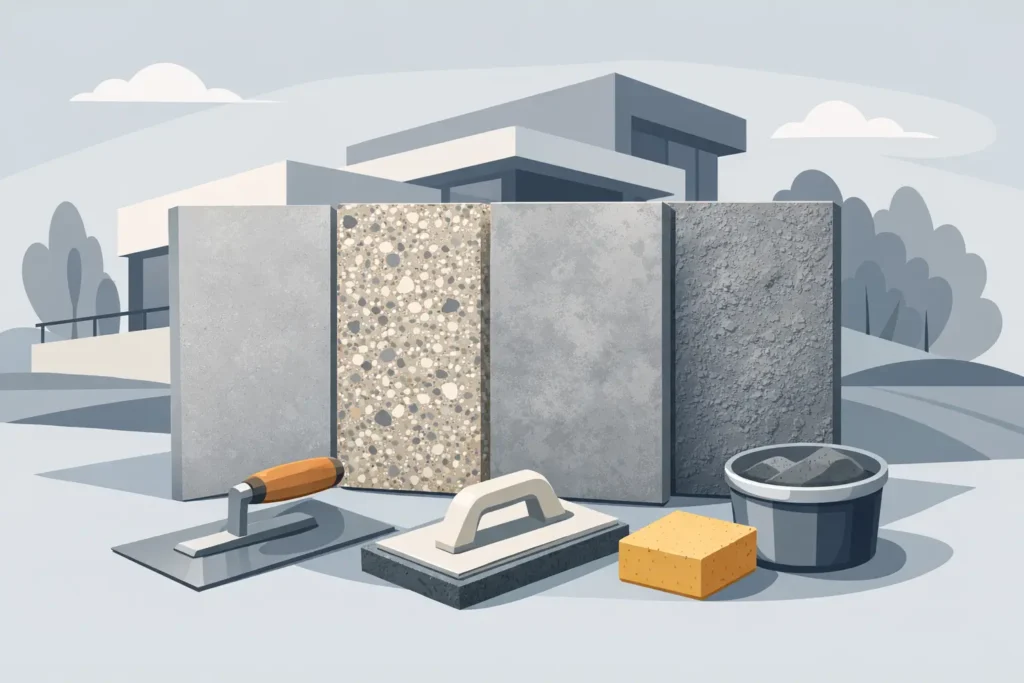
A wall can look solid from the street and still be the wrong finish for the job. We see it often - a surface that looked good on day one but starts showing patchiness, hairline cracking or staining once it has had a proper run through Melbourne weather. That is why choosing concrete render finishes is not just about appearance. It is about how the finish will perform on your substrate, in your conditions, and over time.
For homeowners, builders and property managers, the right render finish does two jobs at once. It improves the look of the building and adds a protective outer layer that stands up to sun, rain and day-to-day wear. The wrong choice can leave you with a finish that marks easily, dates quickly or needs more upkeep than expected.
What concrete render finishes actually do
Concrete render finishes are the final texture, pattern or surface effect applied over a rendered wall. They influence the visual style of the building, but they also affect how the wall sheds water, handles minor movement and hides surface imperfections.
A flatter, smoother finish gives a sharper architectural look, but it can also show defects more readily if the substrate is uneven or the prep work is poor. A more textured finish is often better at masking minor irregularities and can be more forgiving on older walls. That does not mean one is better across the board. It means the finish has to suit the building, the material underneath and the result you want.
For exterior work especially, the finish also needs to cope with Australian conditions. Heat, wind-driven rain and seasonal movement all put pressure on rendered surfaces. That is why workmanship, product choice and correct application matter just as much as the final look.
Common types of concrete render finishes
Smooth finish
A smooth finish is clean, modern and popular on contemporary homes and commercial facades. It works well where you want crisp lines and a refined appearance. On new builds with straight substrates, it can look excellent.
The trade-off is that smooth finishes tend to show more. Any inconsistencies in the wall, poor preparation or later surface marking can become more noticeable. It usually calls for a higher standard of substrate correction and more precise application. If the wall is older or has visible imperfections, a smooth finish may not be the most practical option unless additional prep work is carried out.
Sponge finish
A sponge finish sits somewhere between smooth and textured. It has a softer, slightly mottled appearance that can add character without looking heavy. It is a solid option for residential exteriors where you want a neat finish that still has a bit of tolerance for minor wall variation.
This style often suits renovation work because it can give an updated appearance without over-emphasising every old wall issue. It is also a good fit for clients who want something understated rather than highly decorative.
Textured finish
Textured concrete render finishes are widely used because they are durable, practical and visually adaptable. Depending on the product and technique, the texture can be fine, medium or more pronounced. This type of finish is useful for both modern and traditional properties.
Textured finishes generally do a better job of disguising substrate variation, patch repairs and minor surface flaws. They can also be easier to maintain visually because everyday dirt and wear do not stand out in the same way they can on flatter surfaces. That said, heavier textures can hold more dust in some settings, so the surrounding environment should be considered.
Bagged or rustic finish
A bagged or rustic finish gives a more natural, less uniform look. It is often chosen for feature walls, older homes, garden walls and projects where a softer, less manufactured appearance is wanted.
This can be an effective way to retain some character while still improving the wall surface. It is not the right fit for every property, especially where a very sharp, contemporary look is the goal. But on the right building, it can feel more authentic than an overly polished finish.
Choosing the right finish for the property
The best finish is not always the one that looks strongest on a sample board. Sample pieces are useful, but walls behave differently at full scale, in natural light and across different elevations.
Start with the substrate. Concrete block, brick, fibre cement sheet, blue board and repaired masonry all have different characteristics. Some are more stable, some absorb differently, and some require specific preparation to achieve a reliable bond and even appearance. A finish that works well over one surface may not be the best choice over another.
Then consider the age and condition of the building. On a new extension or fresh facade, you may have more freedom to choose a finer finish. On an older home with movement history or previous patching, a textured system may give a better long-term visual result. This is where experience matters. A good renderer is not just looking at colour and texture. They are looking at how the wall will behave after the scaffold is gone.
Style matters too, but it should be anchored in practicality. A smooth finish can suit a new architectural home beautifully. A more textured render may better suit a fence, retaining wall or investment property where durability and low visual maintenance are higher priorities.
Why product selection matters as much as the finish
Clients often talk about finish as if it is purely cosmetic, but the material system behind it matters just as much. Acrylic render, cement render and specialised coatings all perform differently, and the chosen finish needs to work with the base system rather than against it.
Acrylic-based systems are valued for flexibility and crack resistance, particularly where minor movement is expected. Cement-based systems can provide strength and a solid traditional feel, but they need to be specified and applied correctly for the substrate and conditions. Primer selection, curing time, reinforcement in problem areas and topcoat compatibility all influence the final result.
If shortcuts are taken in preparation, mixing or application, even the best-looking finish can fail early. That is why professional render work is not simply a matter of spreading product across a wall. It is a layered process built on adhesion, consistency and surface control.
Maintenance and long-term performance
No render finish is completely maintenance-free, but some are easier to live with than others. Smooth finishes usually need a bit more care if you want them looking sharp over time, particularly on exposed walls. Textured finishes are generally more forgiving, though they still need proper cleaning methods and quality coatings to maintain their appearance.
Moisture control is another key factor. Render should never be expected to fix underlying water issues on its own. If drainage, flashing or structural cracking is not addressed first, the finish can end up carrying the blame for a bigger building problem. Proper assessment before the work starts saves trouble later.
Quality concrete render finishes should also be matched with suitable coating systems if painting is part of the specification. Breathability, weather resistance and colour retention all play a role in how the finished wall looks after a few years, not just after handover.
Where a professional recommendation makes a difference
A lot of property owners begin with a style preference and then work backwards. In practice, the better approach is to assess the wall first, then narrow the finish options to those that will perform well. That is especially true for repairs, renovations and mixed-substrate projects.
An experienced rendering contractor will look at the condition of the surface, identify any movement or cracking concerns, consider exposure to weather and recommend a finish that fits both the building and the budget. That advice can prevent common issues such as choosing a finish that is too fine for a rough substrate, too decorative for a hard-wearing area, or too difficult to maintain for the type of property.
For clients across Melbourne, that practical approach matters. Local weather can be hard on external surfaces, and not every finish that looks good in a brochure will hold up equally well on site. Getting the detail right at the start usually costs less than rectifying avoidable problems later.
The best render finish is the one that still looks right after seasons of weather, regular use and the small movements every building goes through. If you choose with performance in mind, appearance tends to follow. A wall should not just present well on completion day - it should keep doing its job long after the tools are packed away.