
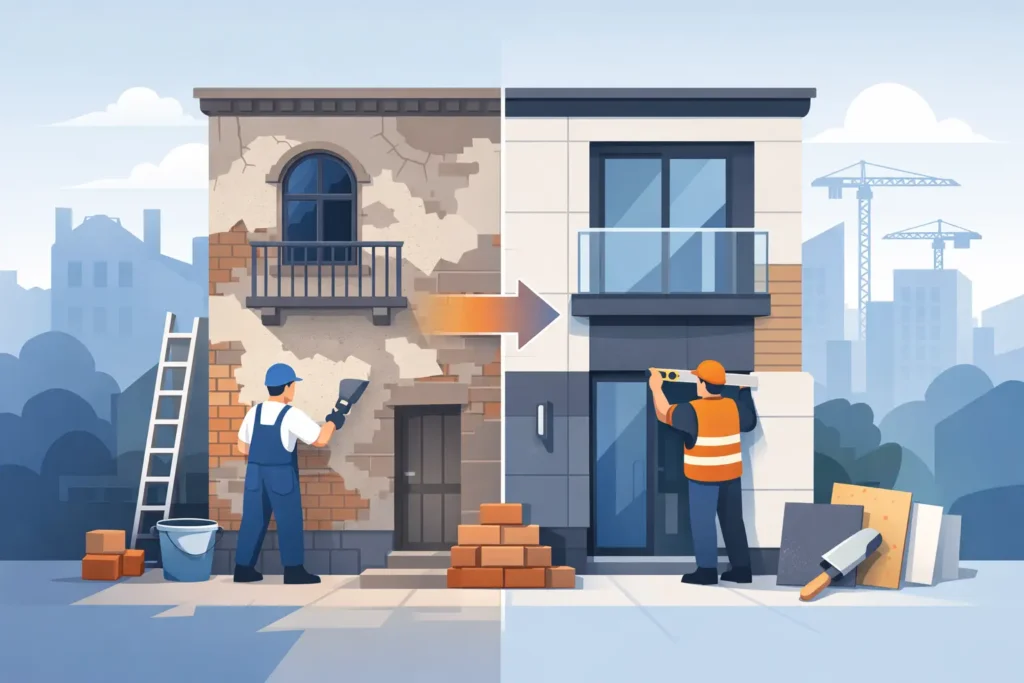
A façade can look tired long before it has reached the end of its service life. Hairline cracks around windows, hollow-sounding render, faded coatings and patched brickwork are all common signs that it is time to act. Knowing how to upgrade old facades starts with one rule: do not cover a failing surface and hope for the best. The underlying wall, moisture paths and existing finish must be assessed before any new render or cladding is installed.
For Melbourne homes and commercial buildings, this matters. Cold, wet winters, hot summer days and regular temperature changes can expose weaknesses in older exterior surfaces. A properly planned façade upgrade improves street appeal, but more importantly, it helps protect the building fabric for the years ahead.
Start with the condition of the existing façade
Every successful upgrade begins with an inspection. Old façades often have more than one issue, and the visible defect is not always the cause. A crack may result from movement around an opening, failed joints, minor settlement, water entering from damaged flashings, or a previous repair that was too rigid for the wall.
Look closely for cracks, loose or drummy render, staining, mould, efflorescence, crumbling mortar, deteriorated paint and areas where the wall remains damp after rain. Check around window frames, parapets, balconies, downpipes and the base of external walls. These locations are common entry points for water.
The substrate also determines what can be done next. Brick, concrete, blockwork, fibre cement, Hebel and previously rendered masonry all require a different preparation method. Sound painted render may only need repairs and a compatible finish. Heavily damaged cement render may need to be removed in sections before the wall is rebuilt. If there is significant movement or moisture damage, that should be resolved before cosmetic work begins.
Repair faults before upgrading the finish
Crack repair is not simply a matter of filling a line in the wall. Fine surface crazing may be limited to the finish coat, while wider or recurring cracks can point to movement in the substrate. The repair method needs to suit the cause and the wall system.
Loose render should be removed back to a firm edge. The exposed area is then cleaned, prepared and built back up with compatible materials so the repaired section sits correctly with the surrounding finish. Depending on the condition of the wall, reinforcement mesh may be used to strengthen vulnerable areas and reduce the risk of cracking through the new surface.
Moisture issues deserve particular attention. Rendering over damp masonry, leaking flashings or failed seals can trap the problem rather than solve it. That can lead to staining, bubbling, delamination and repeated repair costs. A durable façade upgrade deals with drainage, penetrations and water entry points as part of the scope, not as an afterthought.
How to upgrade old facades with rendering
Rendering is one of the most effective ways to modernise dated brick, block and concrete walls. It can create a clean, consistent appearance while adding a protective surface that suits the building and its exposure to weather. The right system depends on the substrate, desired finish and whether flexibility or a traditional appearance is the priority.
Acrylic rendering for flexibility and finish
Acrylic render is a popular choice for homes with older masonry because it has flexibility compared with traditional cement-only mixes. That flexibility can help manage minor movement and makes it well suited to many residential façades. It is available in a range of textures, from smooth contemporary finishes to a more pronounced rendered look.
Acrylic systems need careful preparation and the correct primers. Applied over an unsuitable or poorly cleaned surface, even a quality product can fail. On a sound, properly prepared wall, it offers a durable finish that can refresh an entire elevation or blend repairs into an existing rendered façade.
Cement rendering for solid masonry surfaces
Cement render remains a proven option for brick, concrete and blockwork. It is particularly suitable where a traditional rendered appearance is required or where the wall needs levelling before a final texture or coating is applied. The mix, thickness and curing process all matter. Applying cement render too quickly, too thickly or onto an unstable surface can create shrinkage cracks and poor adhesion.
Cement rendering is not automatically the best answer for every old wall. Where there is ongoing movement, a more flexible system or additional joint detailing may be the better long-term choice. The finish should be selected on performance, not just on the lowest initial price.
Consider cladding when the wall needs more than a new skin
Some façades are beyond straightforward patching and rendering, while others benefit from a complete change in profile. Polystyrene cladding and Hebel cladding can be practical options when a property needs a modern architectural look, improved thermal performance or a new finish over an appropriate existing structure.
Polystyrene cladding systems are lightweight and can create clean lines, bands, feature walls and contemporary details. Hebel panels provide another option for façade upgrades where a solid-looking, lightweight cladding system is required. Both need proper fixing, joint treatment, weatherproofing and compatible render coatings. The details around windows, corners and roof junctions are just as important as the panels themselves.
Cladding is not a shortcut around structural problems. If the supporting wall has water damage, movement or poor framing, those issues must be investigated first. Building approvals, fire requirements and installation details may also apply depending on the property, system and scope of work. For commercial buildings and larger alterations, early planning avoids expensive changes once work has started.
Choose a finish that suits the building
A façade should suit the architecture rather than follow a passing trend. Smooth finishes work well on modern homes but show imperfections more readily, so substrate preparation must be precise. A light texture can be more forgiving on older walls and is often a sensible choice where the building has character or minor surface variation.
Colour selection also affects long-term performance. Very dark colours can absorb more heat, which may increase movement in sun-exposed areas. Lighter tones often suit Melbourne streetscapes, help conceal dust and reduce heat absorption. The final colour system should be compatible with the render or cladding beneath it, particularly where waterproofing and vapour permeability are part of the specification.
It is worth considering the whole exterior at this stage. A renewed façade can make tired gutters, old window trims, uneven paths and neglected fences stand out even more. Coordinating these elements does not mean replacing everything at once, but it helps create a finished result rather than a wall that looks newly done beside worn details.
Plan the work around access, protection and weather
Good workmanship is visible in the preparation as much as the final texture. Before work starts, access needs to be organised safely, landscaping and windows protected, and loose material managed without leaving a mess around the property. For multi-storey homes and commercial sites, scaffold access may be necessary to achieve a consistent finish and complete repairs properly.
Weather affects rendering work. Extreme heat, rain, high winds and very cold conditions can interfere with adhesion, drying and curing. An experienced contractor will schedule stages around suitable conditions rather than rush a coat onto a wall because the calendar says the job should be finished.
Homeowners should also allow for the reality of exterior work. There may be noise during removal and preparation, temporary limits on access to parts of the property, and drying time between coats. These are normal parts of doing the job correctly. A clear scope should explain what is being repaired, which system is proposed, how surfaces will be prepared and what finish is expected.
Avoid the false economy of surface-only repairs
The cheapest quote can become the most expensive option if it leaves loose render in place, skips crack preparation or uses incompatible materials. A façade is exposed every day. Small compromises in preparation can show up quickly as cracking, peeling or water-related damage.
Australian Rendering Company approaches old façade work with the same practical standard used for new rendering: identify the condition of the wall, repair what is unsound, use quality materials and apply the system properly. That is how an upgrade delivers more than a quick visual change.
A well-finished façade should give you confidence whenever you pull into the driveway or arrive at the building. Start with the wall behind the finish, make the material choice for the right reasons, and the improved appearance will have the durable foundation it deserves.