
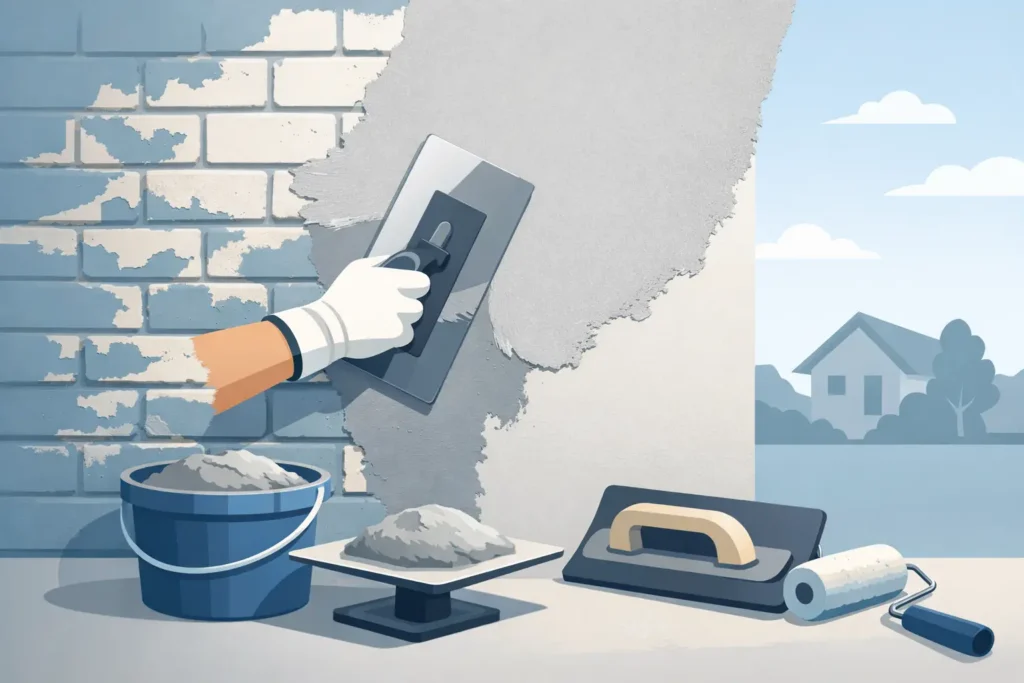
A painted brick wall can look sound from the street and still be a poor surface for render. That is why the question of whether you can render over painted brick walls does not have a simple yes or no answer. The paint, the condition of the brickwork, the wall’s moisture levels, and the render system all need to line up. If they do not, the finish may look good at handover and then start drumming, cracking or de-bonding once weather and movement take hold.
For homeowners and builders, this is where shortcuts usually create expensive problems. Paint changes how render bonds to masonry. Brick and mortar are naturally porous, while painted surfaces can be smooth, sealed and inconsistent. A proper assessment matters more than the age of the wall or how tidy it appears.
When render over painted brick walls can work
In some cases, render over painted brick walls is achievable, but only with the right substrate preparation and system selection. The key issue is adhesion. Traditional cement render wants a stable, absorbent background. Paint often interrupts that bond, especially if it is flaking, chalky, glossy or trapping moisture behind it.
If the paint is firmly adhered, the wall is dry, and the brickwork underneath is in good condition, a specialist may be able to prepare the surface and apply a compatible bonding system before rendering. That could involve mechanical abrasion, high-pressure cleaning where appropriate, patch repairs, a primer or key coat, and then a render suited to the substrate.
The important part is that the render is not really bonding to the brick alone. It is relying on the performance of every layer beneath it. If the paint fails, the render can fail with it. That is why experienced contractors treat painted brick as a risk-managed substrate rather than a standard one.
When it is better not to render over painted brick walls
There are situations where the smarter option is to remove the coating, repair the wall, or consider another façade treatment altogether. If the existing paint is blistering, peeling, powdery or has multiple old coats built up over time, it creates an unreliable base. The same applies where there is rising damp, salt contamination, cracking through the mortar joints, or previous patchwork that has already started letting go.
Older walls can also be unpredictable. You may have sections of hard-fired brick beside softer brick, old repairs with different mortar mixes, or previous coatings that no longer behave consistently. In those cases, rendering over the top can hide underlying issues for a short period, not solve them.
This is particularly relevant in Melbourne conditions, where temperature swings, wind-driven rain and moisture exposure can test a wall over time. A finish that is only as strong as an ageing paint film is rarely the best long-term result.
The preparation work that makes the difference
Preparation is where most of the job is won or lost. If a contractor proposes rendering straight over painted brick with little more than a wash-down, that should raise questions. Good workmanship starts with checking adhesion, tapping for hollow areas, identifying cracks, and testing how the paint surface responds to scraping and cleaning.
Where the coating is suitable to work with, the wall usually needs to be cleaned thoroughly and mechanically roughened to create a key. Any loose or unstable material has to come off. Cracks need proper repair, not just covering. If there are moisture issues, they must be addressed before the render goes on, because render is not a waterproof fix for a wall that is already taking on water.
After the substrate is made sound, a bonding agent or suitable base coat may be applied depending on the system being used. This stage is not generic. Acrylic systems, polymer-modified products and cement-based renders all have different tolerances and requirements. Matching the product to the wall is part of doing the job properly.
Choosing the right render system
Not all render products respond the same way on painted masonry. A standard cement render may work well on bare, properly prepared brick, but painted surfaces often need a more flexible and adhesive system. Acrylic render is commonly considered because it offers improved flexibility and can perform well on a range of prepared substrates. That does not mean it can rescue a bad wall, but it can be the better fit where movement and adhesion are concerns.
For some projects, a full texture coating system over a prepared base may be more suitable than a heavier traditional render. In other cases, removing the paint first is the better investment because it gives the new finish a stronger foundation. There is no single best product for every painted brick wall. The right choice depends on substrate condition, desired appearance, wall exposure and budget.
This is where trade experience matters. Product data sheets matter too, but site conditions decide whether a system will hold up over years, not just weeks.
Common problems when the job is rushed
Most failures on painted brick happen for predictable reasons. The surface was not prepared enough. Moisture was ignored. The wrong primer was used. The render coat was applied over unstable paint. Or the wall had movement and cracking that should have been repaired first.
When that happens, signs usually appear as hollow sounding areas, hairline cracking, bubbling, staining or full sections of render separating from the wall. Sometimes the issue shows up after the first wet season. Sometimes it takes longer. Either way, the repair is more involved than getting it right from the start because failed render often has to be cut back, removed and reinstated.
There is also the appearance side of the job. Painted brick walls can have patched levels, old brush marks, uneven suction and hidden defects that telegraph through the final coat if the base is not corrected. A clean finish is never just about the topcoat. It reflects the preparation underneath.
Is paint removal always necessary?
Not always, but it should never be dismissed without inspection. Full paint removal can add time and cost, and in some cases it may not be essential if the existing coating is sound and the chosen render system allows for that substrate. On the other hand, trying to save money by keeping a failing paint layer can lead to much higher costs later.
A good contractor will weigh the condition of the coating against the risk of future de-bonding. That conversation should be practical, not sales-driven. Sometimes partial removal and localised repairs are enough. Sometimes the wall needs to be taken back to bare masonry. Sometimes render is not the best finish at all.
The honest answer is that it depends on what is actually on the wall and what the client wants the finished system to achieve.
What property owners should ask before approving the job
If you are considering render over painted brick walls, ask how the existing paint will be tested, what preparation is included, and which render system is being specified for that substrate. Ask how cracks and moisture issues will be handled. Ask what finish is realistic, and whether any part of the wall should be stripped or repaired before rendering begins.
These are not minor details. They affect adhesion, appearance and service life. A proper quote should reflect preparation, not just application. Cheaper pricing can sometimes mean the difficult substrate work has been under-allowed or ignored.
For renovators and investors, this matters because render is often chosen to modernise a dated façade and improve value. It can absolutely do that, but only if the base is stable. For builders and commercial property owners, the same rule applies on a larger scale. Performance starts at the substrate.
The practical answer
Yes, you can sometimes render over painted brick walls, but only when the existing surface is sound, the wall is dry and stable, and the preparation and render system are suited to the job. If any of those factors are off, rendering over paint becomes a gamble rather than a finish.
At Australian Rendering Company, that is the difference between a wall that simply looks fresh for a short time and one that is built to last. If the substrate is right, render can transform painted brick into a cleaner, more durable finish. If it is not, the best decision is to fix the wall first and give the new coating a proper foundation.
A painted wall can hide plenty. The smart move is to find out what is underneath before you ask render to carry the load.